
Your Microsoft account team is probably already talking to you about Microsoft 365 E7. It reached general availability on 1 May 2026, it bundles E5, Microsoft 365 Copilot, the Entra Suite and Agent 365 into a single suite, and moving customers from E5 to E7 is a stated priority for Microsoft’s field this fiscal year.
The pitch is straightforward: one licence, everything included, the route from AI experimentation to secure deployment at scale.
Here is my problem with how these conversations are going. E7 is being sold as a licensing decision. It is not. It is an operating model decision wearing a licensing decision’s clothes, and most organisations I speak to are evaluating the price without evaluating the questions the suite forces them to answer.
What Microsoft 365 E7 actually changes
The short version: E7 takes everything in E5, adds Microsoft 365 Copilot as standard rather than an add-on, and layers in two things most organisations have never operated before. The Entra Suite extends identity beyond people. Agent 365 provides a control plane for AI agents: a registry of what agents exist, identity for each one, and the tooling to observe, govern and secure them across their lifecycle.
Read that list again. Copilot is a productivity tool; your teams broadly know what to do with it. An agent registry, agent identity and agent lifecycle controls are something else entirely. They exist because Microsoft expects your organisation to be running a growing estate of AI agents, built by your own business users as much as by IT, and it is giving you the machinery to manage that estate.
Machinery is not a model. The licence gives you the controls. It does not tell you how to use them, who should own them, or what your organisation’s rules should be. That part is yours.
The seven questions the licence doesn’t answer
When I work through E7 readiness with clients, the conversation lands on the same set of operational questions every time. None of them is answered by purchasing the suite.
- Where will E7 create measurable value? Not “where could AI help” in the abstract, but which specific business processes justify the uplift in licence cost.
- Who may create, publish and operate agents? Agent building is now a business-user capability. If your answer is “anyone”, you are choosing that by default, not by decision.
- Who owns an agent in production? An agent that summarises supplier contracts is useful until the person who built it leaves. Then it is an unowned process making decisions nobody is accountable for.
- What data and systems can agents access? Agents inherit permission problems. If your SharePoint permissions overshare with people, they will overshare with agents at machine speed.
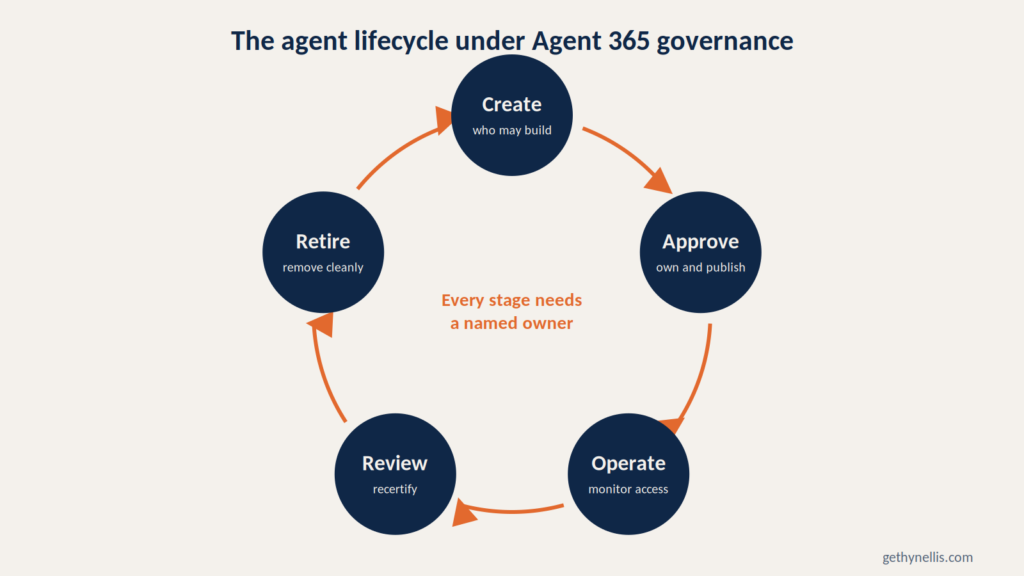
- How are agents reviewed, monitored and retired? Dormant agents are the new shadow IT. Except shadow IT never acted autonomously on your data.
- How do security teams control agent activity without blocking innovation? The instinctive answer, lock it all down, kills the value case you bought E7 for. The absence of an answer creates the next generation of shadow AI.
- How will you evidence the return? Licences deployed and seats activated tell you nothing. If you cannot define what good output looks like, you cannot prove the investment worked.
Notice that only one of those seven is a technology question. The rest are about ownership, accountability and measurement. That is why I say E7 is an operating model decision.
The gap in the market right now
The training and enablement market has good coverage for using Copilot and for building a first agent. Microsoft’s official courseware covers both, and a new administration fundamentals course, AB-900, now covers the basics of Copilot and agent administration.
What barely exists yet is anything covering the operational layer above that: Agent 365 governance in practice, agent identity applied through the Entra Suite, the review and recertification cycle, the retirement process, the division of responsibility between IT, security and the business. The product is months old. The official courseware has not caught up. Most organisations are working this out from first principles, if they are working it out at all.
That gap will not stay open. But right now, the organisations upgrading to E7 are ahead of the guidance available to them, and the ones that treat governance as something to sort out later are accumulating an agent estate they will have to untangle retrospectively. Ihave seen that pattern before with Power Platform/Power BI environments and unmanaged SharePoint sprawl. Retrospective governance is always more expensive than designing the operating model first.
What I would do before signing
None of this is an argument against E7. For organisations serious about agents, consolidating Copilot, identity and agent governance into one suite makes commercial sense, and the alternative, assembling the same capabilities piecemeal, is worse.
It is an argument for sequencing. Before the upgrade conversation becomes a procurement conversation, answer three things. First, a value map: the specific processes where Copilot or an agent earns its keep, and the ones where it will not. Second, a first version of your agent operating model: ownership, sponsorship, approval, review and retirement, on one page, agreed between IT, security and the business. Third, a measurement approach: what you will count at 30, 60 and 90 days that is not just usage for its own sake.
Do those three and the E7 decision becomes easy, because you will know what you are buying it to do. If you skip them and you are buying a control plane with nobody at the controls.
Get the operating model before the agent estate
This is exactly the ground my AI Enablement Programme covers: readiness before rollout, role-based use cases, a defined quality bar, and the governance that keeps the value after the initial push. If your organisation is weighing up the E5 to E7 move, or already holds E7 and is watching agents multiply, the AI Enablement Programme is where I would start. Or get in touch and we can talk through where you actually stand.
0 Comments