
When a story about Nvidia’s leadership becomes a story about the future of AI, it raises a useful question. How did one company become so important to technology that your business may use every day?
On 8 November 2026, Nvidia announced an independent investigation following reports that its chief executive, Jensen Huang, had been targeted by a foreign intelligence effort. Its board said it had no reason at that point to believe company secrets or national security had been compromised. Nvidia board statement, 8 November 2026.
On 11 November, Reuters reported that Nvidia’s board was meeting to consider Huang’s future. That report described a potential leadership change. Reuters reporting, 11 November 2026. And as of now the CEO has resigned.
Those dated developments provide the starting point for a bigger business question. If your organisation depends on AI, what are you depending on underneath the product name?
What is the AI arms race?
The AI arms race is competition between companies and countries to control the technology, infrastructure and customer relationships behind artificial intelligence. It includes chips, data centres, models and workplace software. For an IT leader, the practical consequences include supplier dependency, switching costs and the economics of running useful AI.
There are several races happening at once. A company can lead in one area while depending heavily on another company somewhere else.
Computing capacity
Training and running AI require computing resources. Those resources need processors, memory, networking, buildings and electricity. Owning a capable model is only part of the job. A supplier also has to make it available at a cost and speed customers will accept.
That makes infrastructure strategically important. For a buyer, it means the service behind the screen deserves attention alongside the feature demonstration.
Model capability
Model developers compete to handle more difficult tasks, produce more dependable results and serve customers efficiently. A new release might improve one workflow while changing the behaviour of another.
For your business, the useful test is whether it can perform your task consistently, using your information and meeting your acceptance criteria. A benchmark score gives you one piece of evidence.
Access to everyday work
Distribution matters too. Microsoft brings Copilot into applications including Word, Excel, Outlook and Teams. That puts AI inside places where people already work, with familiar routes to documents and collaboration. Microsoft’s overview of Copilot across its applications.
That helps explain why the product that reaches your users can matter as much as the model behind it. Adoption involves access, integration, permissions, training and habits.
National influence
Governments also have a stake in who controls strategically important technology. Nvidia’s own board statement explicitly connects its investigation to US national and economic security. Decisions made around AI infrastructure can therefore involve considerations well beyond an ordinary software purchase. Nvidia board statement.
Why Nvidia matters so much
Nvidia’s position includes the software around its processors. CUDA provides a platform, libraries and development tools for GPU-accelerated computing, with applications including AI model training and inference. That combination helps explain why changing hardware can also mean changing software and engineering practices. Nvidia’s explanation of CUDA.
For a UK business buying a hosted AI service, that dependence may sit several steps away from the contract. Your direct supplier might depend on a cloud provider, which in turn depends on particular hardware and its associated software.
The business question is how a disruption or strategic change could travel through those dependencies, and what your supplier has done to manage it.
What sits behind your AI tool?
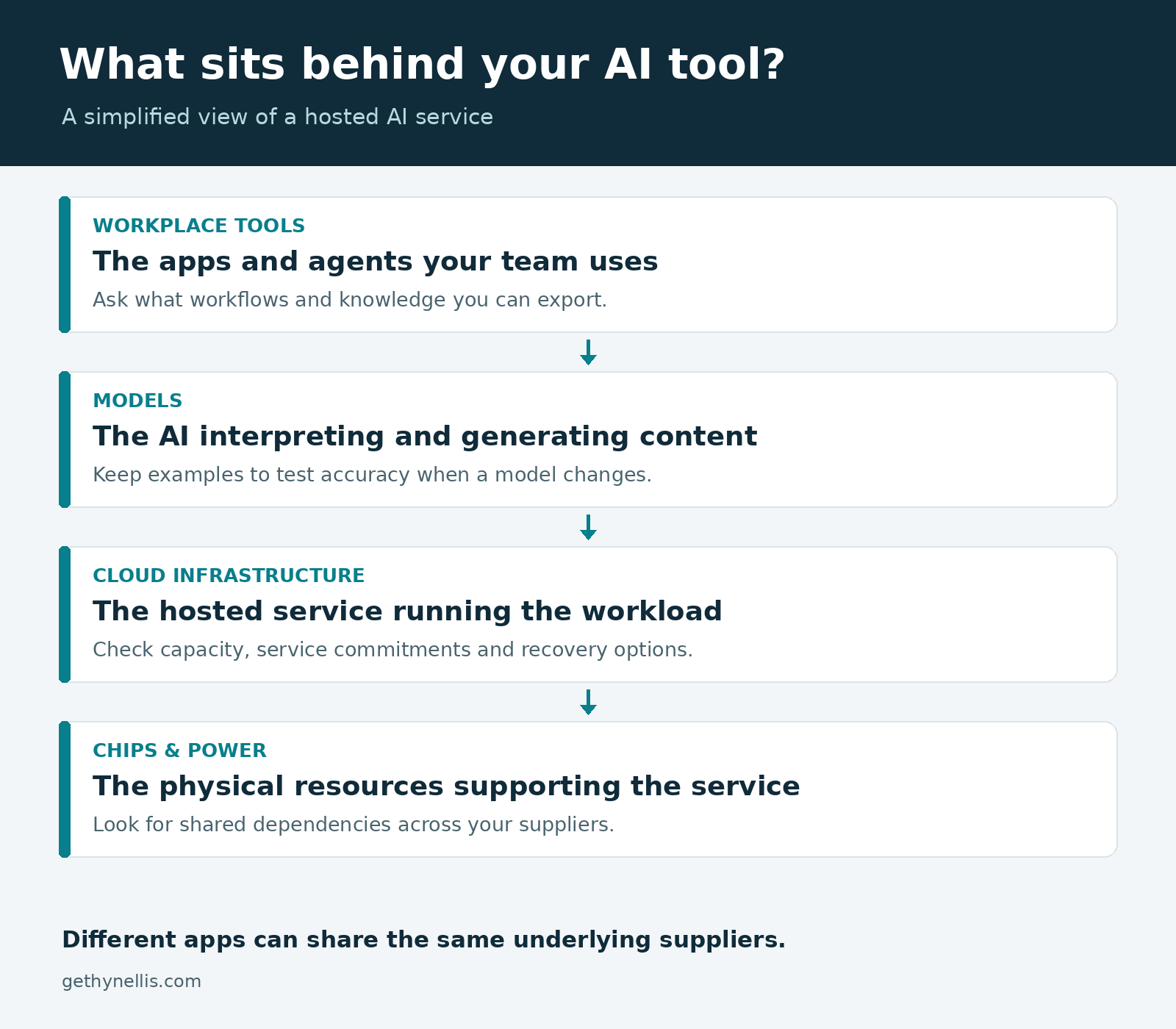
This is a simplified view of a hosted service. A supplier may operate several layers, and the detailed architecture will vary. The point is to ask about the dependencies that matter to your workflow.
Buying two applications from different vendors can still leave you exposed to the same underlying service. Supplier diversity is something to investigate at the relevant layer.
Five questions for your next AI review
- Which dependencies matter to this workflow? Ask about the model and hosting arrangements your supplier can disclose. Record the business impact if the service becomes unavailable or changes.
- What can we keep running? Define a workable fallback for important processes. Give someone responsibility for deciding when to use it.
- What does a successful outcome cost? Include licences or usage charges, integration, staff review and rework. Measure the cost of completing the task to an acceptable standard.
- What could we take with us? Check access to your source documents, instructions, workflow definitions and test cases. Estimate the effort of moving them to another service.
- How will we know a change has affected quality? Keep representative examples and agreed expected outcomes. Repeat those checks when the model, configuration or source information changes.
The depth of that review should reflect the impact of failure. Drafting an internal meeting summary and routing an urgent customer request have different requirements.
A practical example
Imagine an AI-assisted customer enquiry workflow. It reads an incoming message, identifies the topic, finds relevant guidance and drafts a reply for a member of staff to approve.
The demonstration may look impressive. The operational questions go further. Does it send an enquiry to the right team? Does the draft use current guidance? Can staff see the source? What happens when the service is unavailable?
Keep a small, representative set of enquiries with expected routing decisions and references to approved guidance. Use that set to assess changes and possible replacements. Document a manual route that staff can actually follow.
You then have evidence about the process, a way to compare suppliers and a fallback. Those remain valuable as the technology changes.
What I would prioritise
For an SME IT leader, I would begin with one useful workflow, an accountable owner and a measurable baseline. Document its important dependencies and decide what acceptable performance looks like before expanding it.
The AI arms race will keep producing announcements, competing claims and changes of direction. Your organisation still needs to answer a more immediate question. Is the technology helping people complete valuable work at an acceptable cost and level of quality?
When you choose an AI platform, you are buying into a supply chain. Understanding that supply chain belongs in your technology strategy.
Start with your organisation’s readiness
If you are deciding where to begin, use the AI Readiness Assessment to structure the conversation about your organisation’s starting point. Take the AI Readiness Assessment.
For support with governance, practical training and measurable adoption, see how we structure our work with organisations. Explore the AI Enablement Programme.
Featured image is an AI-generated conceptual illustration. Supply-chain graphic by gethynellis.com.
0 Comments