

Building your brand can help your career and it can help you make an impact. If you are new to IT, maybe you are fresh out of university or come to the IT industry through some other route like an apprenticeship, and you have landed your first role in IT, then building your brand can help you quickly grow your career and allow you to progress.
Building your Brand and Making an Impact – A useful guide for Individuals new to IT and Data
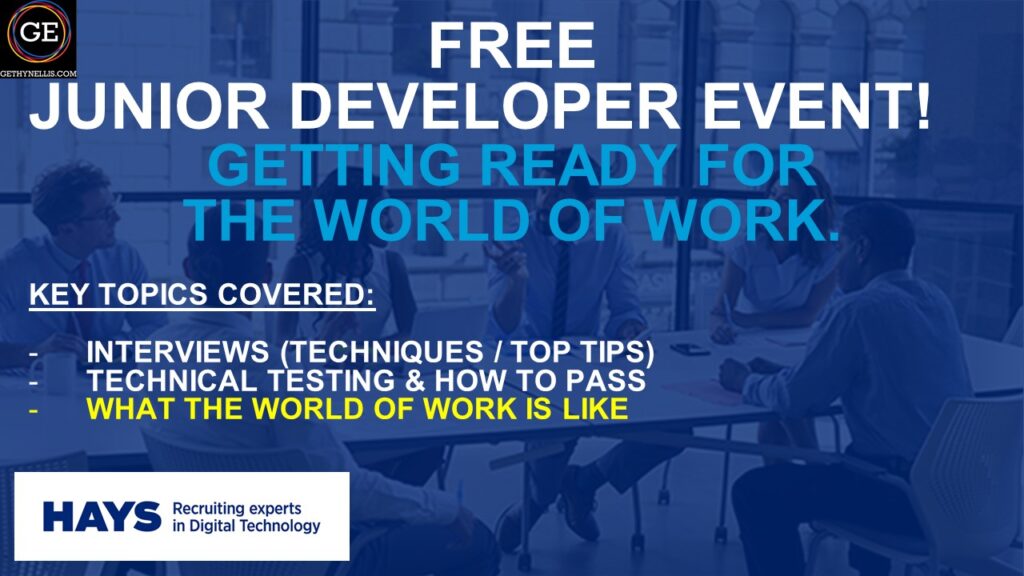
Junior Developer Event
I decided to write this post off the back of a presentation I delivered at an event at the end of March. Hays (a large IT Recruitment firm) and David Williams asked me to contribute to their event for new IT professionals. My talk was about making an impact and growing your career after securing that first role. There were two other Speakers, Mark Williams and Mike Oram, who shared some excellent insight on interview techniques and getting to grips with technical tests. Undoubtedly these will be critical skills for someone to secure that first position.
I decided to turn my talk into a story. My story was about someone new to IT starting in the business. My story involves a few characters:
- Berry Wand (student/junior developer)
- Graham Coops (Database Manager)
- Wendy Lee (hiring Manager)
There may be a few others too, and while it is not a true story in the strictest sense of the word, the characters are fictitious I have based it on real-life events, and no, Berry is not me.
Congratulation, you have secured your first job.
First Job Application Support
So you’re a junior developer. In our story, our junior developer is called Berry Wand. Berry is a graduate. She doesn’t have to be a graduate. Berry may have achieved skills and qualifications in another way. Either way, she now finds herself in a Junior developer or IT role. Berry has followed the great advice from Mark and Mike, and she has secured her first role. She will be working for a small fire service based in the northeast of England.
Good stuff. Berry shone in her interview. She had excellent technical skills that she had learned in university, where she had demonstrated a natural aptitude for technology. The hiring manager Wendy offered her a job in her team in Application Support.
That’s the first few hurdles cleared—well-done, Berry. But now the real work starts properly. You could argue, graduate or not, that securing your first role in the IT industry is like passing your driving test. When you have passed your driving test, it doesn’t instantly make you the world’s best driver. Getting your first job in IT doesn’t make you Bill Gates. It means you now have the opportunity to learn to drive correctly and get those green P plates removed.
A “stepping stone” job
Berry knew this first job was a stepping-stone in her career. She didn’t see herself working in application support long term. Berry wanted to work with data and infrastructure. But all those jobs that interested her required that dreaded word EXPERIENCE, and she didn’t currently have any, so any job working in IT was an excellent start for her.
Technical Skills and fitting into a team
Berry thought she had excellent technical skills. She did, and she was competent. The comments and feedback from Wendy as she was fantastic at fixing technical problems, but she didn’t exactly get on with everyone. She had been overheard bad-mouthing colleagues and being derogatory to other team members. “How can you work here for 20 years. As soon as I can get a job in the database team, I’m off.” These are some of the comments that others had heard in the team
So while Berry had made a positive impact, there were some things that she could have done better. She had great technical skills but wasn’t an excellent fit for the team. Berry perhaps unintentionally gave the impression that she either didn’t want to be there or didn’t value the work that she and the rest of the group were doing.
Application Support in the Fire Brigade involves supporting firefighters in front-line emergency response, playing an important role.
Understand the Organisations Goals
There is nothing wrong with Berry using the job as a stepping stone. Using any job as a stepping stone is fine. There is nothing wrong with that, but you have to have some awareness of the people and team around you. Understand the value they bring to the organisation and how that team helps deliver on the organisation’s goals.
Without that understanding, you might struggle to achieve your goals because there is a fair chance people won’t connect with you. In Berry’s case, she probably didn’t need to alienate the other team members. Perhaps she could have approached her current role with a little more emotional intelligence – using the people-skills that all good technical folk need to be successful. “I know I’m not going to do this forever, but for now, I’m going to be spending some time here. I may as well build relationships with people and do the best job I can.”
Start with the end in mind – Have a Career Plan.
Start with the end in mind, have a plan, take advice from people who have walked the same or similar path to you. You don’t have to take the same path but listen and learn and use their experience to help you make good decisions.
Fortunately for Berry, the minor problems she encountered didn’t hold her back. People are generally forgiving, especially of someone in their first job. Knowing that Berry had a desire to work in his team, Wendy asked Graham how Berry could prepare to apply for a database team’s career should an opportunity arise and there was, in fact, a job in the offing. Not being too long out of university myself, Graham asked me to chat with her and talk about how she could prepare. I’d learned a few things and was happy to share.
Gaining Experience
The catch 22 problem many new entrants to the IT industry face. Job Descriptions that require experience. I wrote a blog on this ten years ago, which I read again when preparing my talk and writing this post. My blog was about how a DBA can gain experience. Most of which is still relevant today.
Now when it came to Berry and the potential for a job in the Database team. I knew on the job spec there was a requirement for the person to have some experience working with database technology.
When I sat down with Berry, we had a chat. She knew a lot about database technology. She had spent some time studying this in university, but she didn’t have any real-world experience, and she didn’t know how to get any. So I replied with – Do you have SQL Server developer edition on your laptop or PC at home. No was the reply. I explained that people generally judge your experience with the questions you answer at an interview, the problems you can demonstrate you can solve when in your role. Or a technical test where you will be solving problems.
As long as you can fill the application form, so you don’t get sifted out by not having the experience, you can demonstrate that experience in the interview calling on all the problems you have worked on and helped fix.
Building Your Brand: Gaining Experience
“How can I do that?” Berry asked.
Well, if you have SQL Server developer edition. (It wasn’t free at the time, but it is now) You can get real-life experience looking at technical forums and Q&A sites, SQL Server Central, Stack Exchange, the MSDN forums etc. If you can understand some of the problems people are experiencing, looking at the suggested solutions others have offered up, then try them for yourself, you will get experience. You can even try and answer some of them if you think you have a solution.
You want to work with technology and data. This career is ultimately a problem-solving job. The more you practice, the better you will be. It’s why employers ask for experience in the first place—so working in your own time in the area that you do want to work in means you can build your knowledge and call on that at an interview. You know the technology we work on here, it’s SQL Server and Oracle, and you know that job needs some SQL Server experience. The team will happily share things with you to focus on the technology areas that will help you get the job. This process helps build your brand and your profile outside of your existing environment too. It’s a win-win for you.
Making an Impact: Fitting into the team
Berry and I built up a bit of a rapport at this point, and she asked how I deal with the yearly review etc. Her first one was coming up. So I said I write down everything I think is of value to the organisation and me as I go through the year. I then use this as evidence for the review process and how I’ve met my objectives. It lets me spot areas that I haven’t done so well, and I then look to develop those through training and other professional development opportunities in the coming year.
Peer Feedback
I went on to explain that you will also need feedback from your colleague’s. The organisation likes team input into individuals review. For me, it’s the most valuable part of the process. You are understanding from colleagues how I have helped or hindered them over the year. What you get from your peers will be constructive and helpful. Berry, in truth, looked a little shocked at this. “I need feedback from others in my team?” she asked.
I replied with, “Yes- it’s essential and has a significant effect on your review rating. Don’t worry, though. Those are usually the best ones. Your peer’s feedback can be priceless and can you lots of opportunities to learn.”
Write a blog, deliver a presentation share your knowledge.
Also, I said as we were finishing our meeting. You might want to consider writing a blog or making presentations. Start small, write on your team’s wiki page in work, or document key processes, so it is helpful to others. Berry asked, “Why do I want to share this stuff? Knowing this is what makes me different?”. I said a lot of people would know this stuff. Your ability to articulate through writing or presenting not only shows you know this stuff, but it also opens you up to feedback from a wider audience which again helps you further learn the subject in more detail. You’ll find by sharing what you know when it comes to performance reviews and other job interviews, both internally and externally, that your work in the public domain will only serve to help you. By sharing and helping others, you will undoubtedly help your future self. If you can do so and confidentiality and NDAs allow it, you can share on a blog or website. The sharing of content helps you build your brand both in work and with potential new employers in the future.
Making an impact: Sharing brings success
Berry listened, spoke with her colleagues and got feedback for her review. She quickly understood how her attitude could have been a hindrance to her progressing. Berry Got SQL Server developer edition. She got the experience in the technology that allowed her to meet the requirements of the database. Through blogs and wikis internally at first and lunch and learns presentations with her team, she shared what she had learned and helped others learn too. All of this built her brand, demonstrated her skills and raise her public profile. She now has a job at a leading technology company – a blue badge.
Key takeaways
I think you can summarise the moral of this story in six points.
- Getting the job is just the beginning. The real journey starts now.
- Understand what value you can deliver to your new employer, what problems you can help them solve and that will help you fit into the team
- Learn how to work with people of different backgrounds and cultures with different needs and wants from yourself. The world of work usually involves a lot of teamwork, so learning to get on with other people will be vital for you and them.
- Understand how the work you do fits into the organisation’s goals, and then you’ll have a genuine appreciation of what you are doing and how it makes a difference to your business.
- Stand out, build your brand – Write your achievements down, share them publicly, start a blog, get involved with “lunch and learn” and team learning events. You can even speak at conferences (DataWeekender Call for speakers is open until 10th April 2021)
- Have your end goal in mind. That way, you can map out how you are doing now to help you get to where you want to be.
Suppose you are new to the IT industry. You could be a recently graduated student, an apprentice looking to build a career or simply trying to break into the IT industry. We offer a student mentoring programme here at gethynellis.com. If this interests you, please feel free to reach out and contact us
0 Comments
Trackbacks/Pingbacks