
The real test of an AI enablement programme isn’t the certificate. It’s what changes on Monday.
Most corporate AI training produces two things: a feeling of momentum and a folder of completion certificates. Neither shows up on a balance sheet. I’ve sat through enough vendor-led sessions to know the pattern. Everyone leaves energised, nobody changes how they work, and six weeks later the licences are paying for tools no one opens.
So when something different happens, it’s worth writing down.
This week, partway through (Week 8 of 12) an AI enablement programme I’m running for a large organisation’s IT function, one of the delegates told the room that work prompted by the programme had led his team to automate a process they’d been doing by hand for years. His own estimate of the savings was in the region of $400,000.
I’ll be honest about what that figure is and isn’t. It’s a delegate’s own number, shared mid-delivery, not an audited finance-signed line item. I’d want to capture the detail properly before treating it as gospel. But even with that caveat, it tells you something the certificate never does: a real process changed, and the change was big enough that the person responsible put a number on it unprompted.
Why is this the exception, not the rule
The uncomfortable truth about AI upskilling is that most of it teaches tools, not outcomes. People learn what Copilot can do, or how to build a flow in Power Automate, and then return to a backlog that gives them no time or mandate to apply any of it. The knowledge evaporates. That’s not a failure of the people. It’s a failure of design.
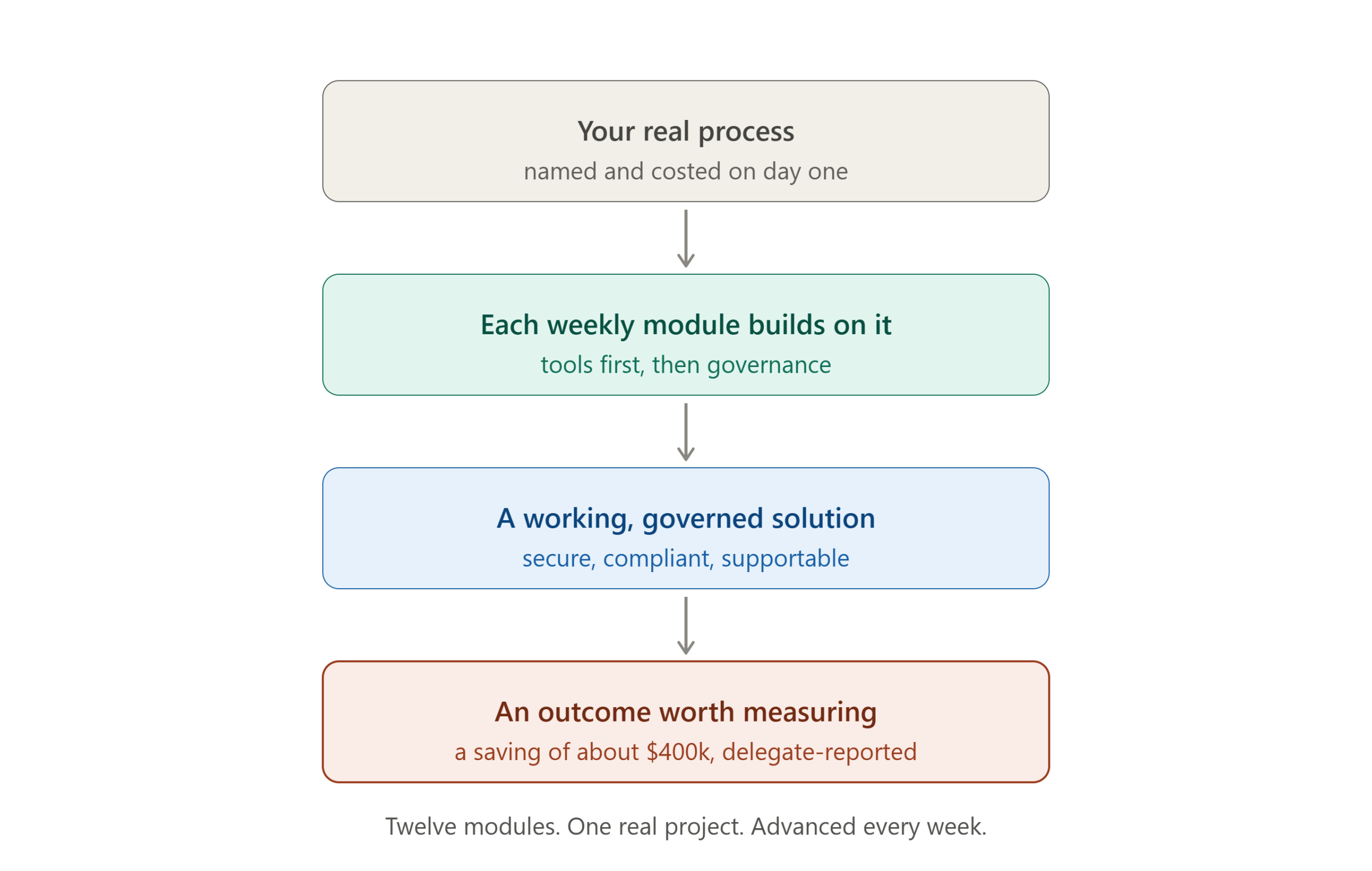
The thing that made the difference here wasn’t a cleverer demo. It was that every session is anchored to a real piece of work the delegate already owns. Nobody builds a toy app to pass an exercise. They bring a genuine, painful, recurring process from their actual job, and the programme exists to move that specific thing forward, week by week.
When you structure enablement that way, the learning has somewhere to land. The $400,000 didn’t come from the training in the abstract. It came from a person who already understood the process well enough to know what it cost, finally being given the tools and the permission to fix it.
What “anchored to real work” actually means in practice
It’s easy to say training should be practical. Most providers say it. Far fewer build it in a way that survives contact with a busy delegate. Here’s what I’ve found makes the difference.
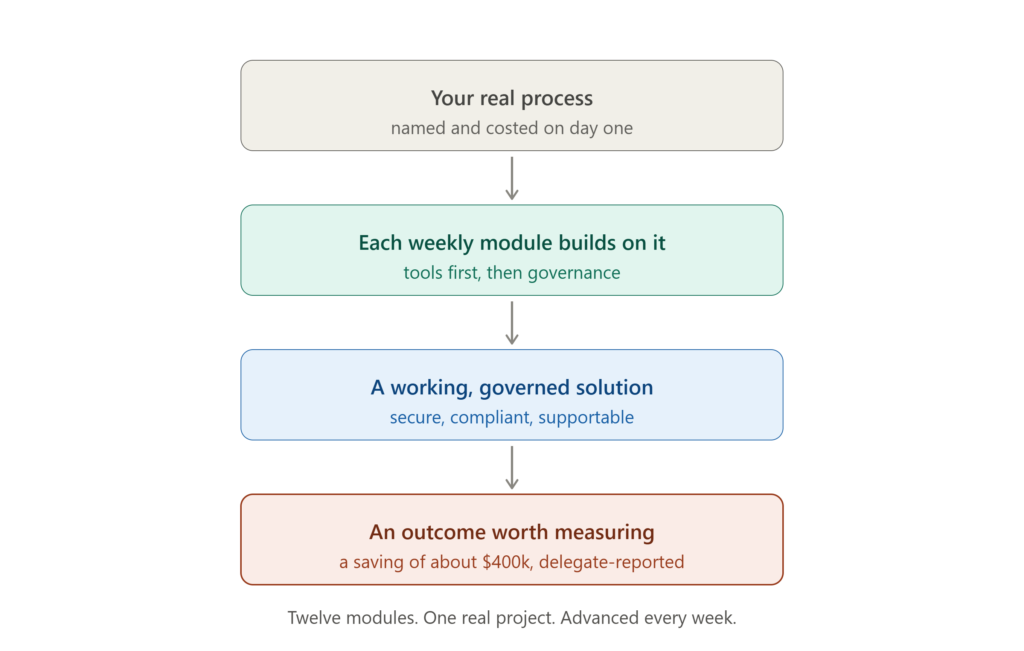
One real problem per person, named on day one. Not a hypothetical. A specific process, a specific beneficiary, and ideally a number attached to how much it currently costs in time or money. If a delegate can’t name those three things, the rest of the programme has nothing to grip onto.
Every module advances that problem. Each session isn’t a standalone topic. It’s another layer added to the thing the delegate is actually building. By the end, they don’t have a certificate. They have a working, governed solution they can stand behind.
Governance is in the room from the start, not bolted on. Automations that touch real business data have to be secure, compliant and supportable, or they get switched off the moment someone in IT security notices them. Building that thinking in early is the difference between a clever proof of concept and something that survives.
The scepticism still stands
None of this means AI is about to transform every organisation overnight. I remain as sceptical of the breathless claims as I’ve always been. Most AI initiatives still underdeliver, and they underdeliver for boring, structural reasons: no clear problem, no ownership, no follow-through, no governance.
That’s exactly why a single concrete result is worth more than a hundred glossy case studies. It’s evidence that when you fix the structural problems, the technology does the rest. The tools are genuinely capable now. The bottleneck has moved. It isn’t the AI. It’s whether your people are equipped and permitted to point it at something that matters.
The takeaway
If you’re commissioning AI training and the success measure is attendance or satisfaction scores, you’re measuring the wrong thing. Ask a harder question. Six weeks after the programme ends, what is being done differently, and what is it worth? If the provider can’t tell you how the training is designed to produce that answer, it probably won’t.
One delegate, one process, one number. That’s what good enablement looks like.
Work with me on this
I design and deliver AI enablement programmes that are built around your people’s real work, not generic demos, so the learning produces something you can actually use. If that’s the kind of outcome you’re after for your team, take a look at how the AI enablement programme is structured, or get in touch and we’ll talk through what it would look like for you.
0 Comments