
Microsoft has introduced AB-620, the exam behind a new credential: Microsoft Certified AI Agent Builder Associate. It is Microsoft’s first certification focused specifically on building enterprise AI agents using Copilot Studio and the wider Microsoft AI ecosystem, and it reached general availability in June 2026.
On the surface, it is another certification. In reality, it tells us something much bigger.
Microsoft is signalling that organisations are moving beyond experimenting with AI assistants. The next phase is designing, integrating and operating AI agents that become part of real business processes. For consultants, developers and IT leaders, that is the important story, and it is the one I want to focus on here. This is not an exam review.

We’ve moved beyond prompts
For the past two years, most enterprise AI conversations have revolved around prompt engineering, Microsoft 365 Copilot, generating documents and summarising meetings. Useful? Absolutely. I have built a good part of my consulting practice on exactly that. But none of it changes how an organisation actually operates.
AB-620 is different. It assumes AI agents are expected to connect to enterprise systems, call APIs, retrieve organisational knowledge, execute business processes, collaborate with other agents, and operate under governance and security controls.
That is a very different level of capability, and a very different kind of professional.
Who is the AB-620 certification aimed at?
This is not an entry-level AI certification. Microsoft positions it for professional developers and advanced builders who design and integrate enterprise-grade agent solutions using:
- Microsoft Copilot Studio and Microsoft 365 Copilot
- Power Platform, Dataverse and Power Fx
- Microsoft Foundry and Azure services, including Azure AI Search
- REST APIs and enterprise connectors
- Model Context Protocol (MCP) and Agent2Agent (A2A) integration patterns
In other words, this is the person building the plumbing behind AI adoption.
What does AB-620 actually cover?
The published skills fall into three broad areas, and the shape of them is revealing.

1. Planning and designing agent solutions
Rather than creating a chatbot, candidates are expected to design complete solutions: choosing the right architecture, selecting knowledge sources, deciding when an agent should use MCP, and understanding orchestration, governance, identity and security. These are architectural decisions, not prompting decisions.
2. Building and integrating agents
This is probably the biggest change. Microsoft expects candidates to understand how agents interact with the wider enterprise: APIs, custom and enterprise connectors, Azure AI Search, MCP, multi-agent orchestration, computer use, and human-in-the-loop workflows. This is a long way from “build a chatbot”.
3. Operating agents in production
This is the area many organisations still underestimate. Building an agent is only the beginning. AB-620 expects candidates to understand testing, monitoring, deployment, application lifecycle management, security, governance and responsible AI.
That is encouraging, because in my experience it is exactly where AI projects fail. Not in the demo. In month three of production.
A platform certification, not a product certification
One thing that struck me is how broad the syllabus has become. This is not solely a Copilot Studio exam. Across the skills outline you will find Copilot Studio, Power Platform, Dataverse, Power Fx, Microsoft 365 Copilot, Microsoft Foundry, Azure AI Search, REST APIs, Adaptive Cards, MCP, A2A, RAG and enterprise connectors.
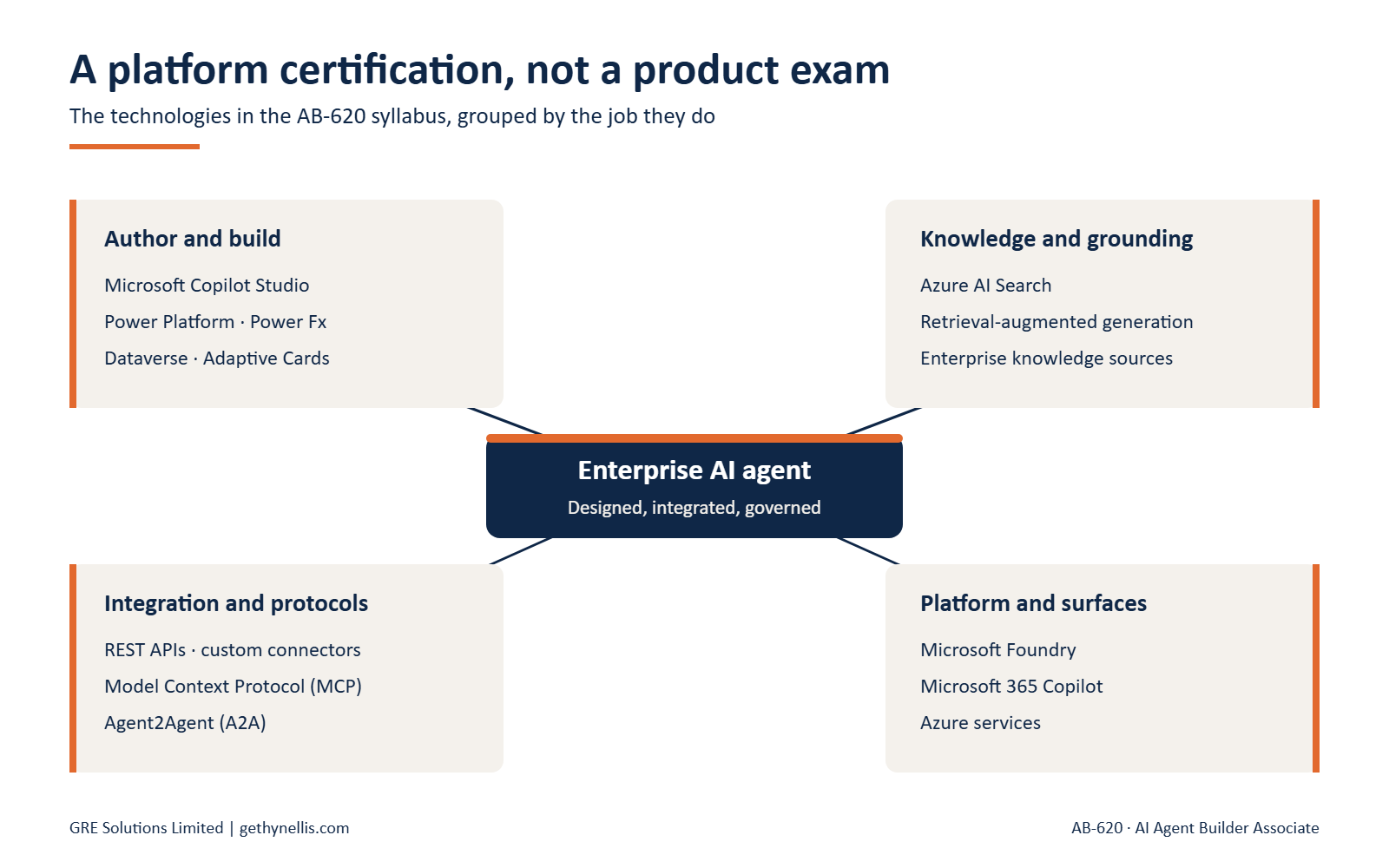
Microsoft is certifying the ability to compose an agent solution across the platform, not the ability to click through one product. That mirrors what I see in client work: the valuable skill is knowing which piece to use where, and how they connect.
What AB-620 tells us about Microsoft’s strategy
This is the part I think most coverage will miss. Microsoft’s certifications usually reveal where it believes customer demand is heading. A few years ago the new credentials were Power BI, Azure data engineering and Microsoft Fabric. Now we are seeing AI Business Solutions Architect, AI Agent Builder, Foundry and Copilot Studio.
That tells me Microsoft expects organisations to build teams around enterprise AI, not simply buy Copilot licences. The job roles are becoming more specialised, and the accompanying instructor-led course, AB-620T00-A, arrives at the end of August 2026, which suggests Microsoft expects partner-led training demand to follow quickly.
Should you take AB-620?
It depends on where you sit.
Yes, if you:
- Build Copilot Studio solutions or work with Power Platform
- Develop enterprise AI solutions and integrations
- Design business automation
- Are moving towards agentic AI consulting
Probably not, if you:
- Only use Microsoft 365 Copilot day to day
- Are looking for a fundamentals certification
- Mainly consume AI rather than build with it
If you are still learning the basics, there are better starting points. AI-900 and the Copilot adoption courses will serve you better before you attempt this one.
My view
I think AB-620 is one of Microsoft’s most significant new certifications. Not because of the exam itself, but because it marks the point where Microsoft officially shifts the conversation from AI assistants to AI systems.
The organisations getting real value from AI over the next few years will not simply have better prompts. They will have well-designed, governed agents integrated into the way their business operates. That is exactly what AB-620 is trying to validate.
Even if you never sit the exam, the AB-620 study guide is worth reading. It is a useful checklist of the capabilities organisations will increasingly expect from the consultants, architects and developers building their AI solutions. It is less about passing an exam and more about understanding where enterprise AI is going next.
Where to go next
If your organisation is somewhere between “we have Copilot licences” and “we run governed agents in production”, that gap is precisely what my AI Enablement Programme is built to close: readiness, role-based use cases, prompt discipline and the operating model that makes agentic AI stick. And if you want the practitioner reference behind it, my book AI That Actually Works covers the frameworks and patterns in full.
0 Comments