
The most common mistake I see in AI-assisted job hunting is also the most tempting one: pasting a job advert into ChatGPT and asking it to write your CV.
It feels productive. It is actually the fastest way to produce an application that fails, because it gets the job of the AI exactly backwards. The model’s job is not to create your experience. It is to reshape the experience you already have so it lands against the requirements you already know matter. Tailoring, not generating. That distinction is the whole of Phase 2 of the Evidence-First approach, and it is worth being precise about.
Why generated CVs fail
Three reasons, and the state of play data covered in this series backs each one.
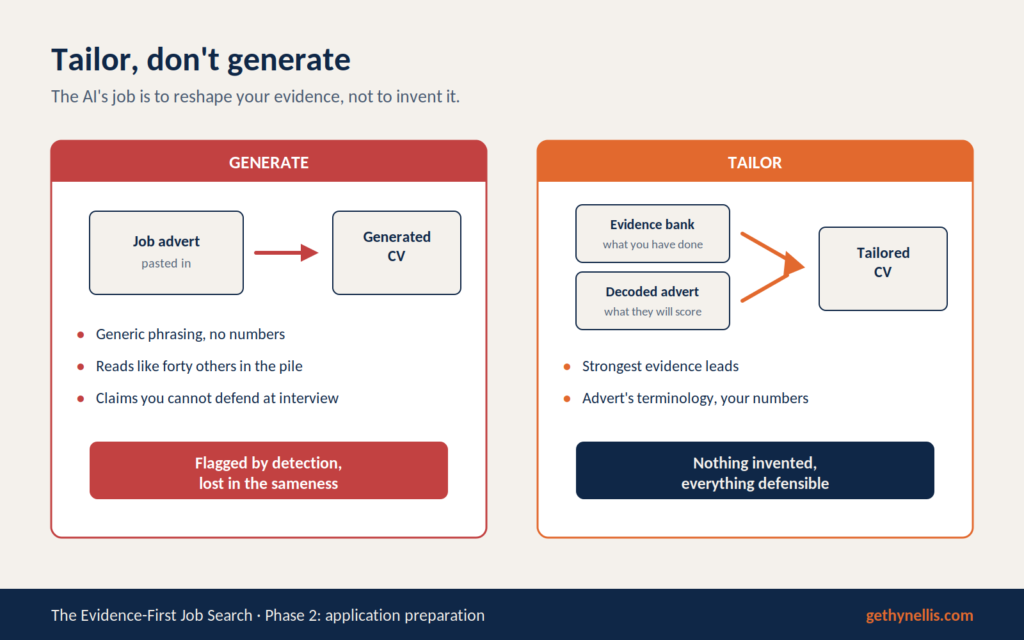
First, detection. AI screening reads most applications before a human does, and increasingly the same stack is scoring applications for signs they were machine-written. A generated CV walks straight into that filter carrying every tell: generic phrasing, evenly weighted bullet points, claims with no numbers attached.
Second, sameness. When 140 applications land for one vacancy and a growing share of them came out of the same handful of models prompted the same way, generated CVs converge. Yours reads like forty others in the pile. The screening layer cannot distinguish you because there is nothing distinguishing left.
Third, and worst, the interview. A generated CV makes claims you did not write and may not be able to defend. The gap between what the document says and what you can actually talk about is precisely what a competent interviewer, or an adversarial screening question, is designed to find.
Generation manufactures evidence. Tailoring deploys it. Only one of those survives contact with the process.
The two inputs you need first
Tailoring only works if you have something to tailor from and something to tailor towards. This series has built both.
From: your evidence bank. The structured record of what you have done, with numbers, that you built in the first post. This is the sole source the model is allowed to draw on. That constraint is not a stylistic preference; it is the mechanism that makes the output defensible.
Towards: the decoded requirements from the advert decode. You know which requirements the screening layer will score, which are padding, and where your evidence is strong. The tailoring job is now specific: lead with the evidence that maps to the hard requirements, in the language the advert uses.
The tailoring prompt
The shape of the prompt, drawn from the whitepaper’s prompt library:
Here is my evidence bank and a job advert with its decoded hard requirements. Rewrite my CV’s profile and role bullets so the strongest evidence for each hard requirement leads. Use only what is in the evidence bank. Do not invent, inflate, or add anything not present in it. If a requirement has no supporting evidence, tell me; do not paper over it. Keep my numbers exactly as given, mirror the advert’s terminology where it is accurate to do so, and flag every change you make so I can review each one.
The instruction doing the heavy lifting is the no-invention constraint. Without it, every model defaults to helpfulness and quietly upgrades your experience. With it, the model becomes an editor rather than an author, which is the only role it should have anywhere near a document you will be questioned on.
Before and after
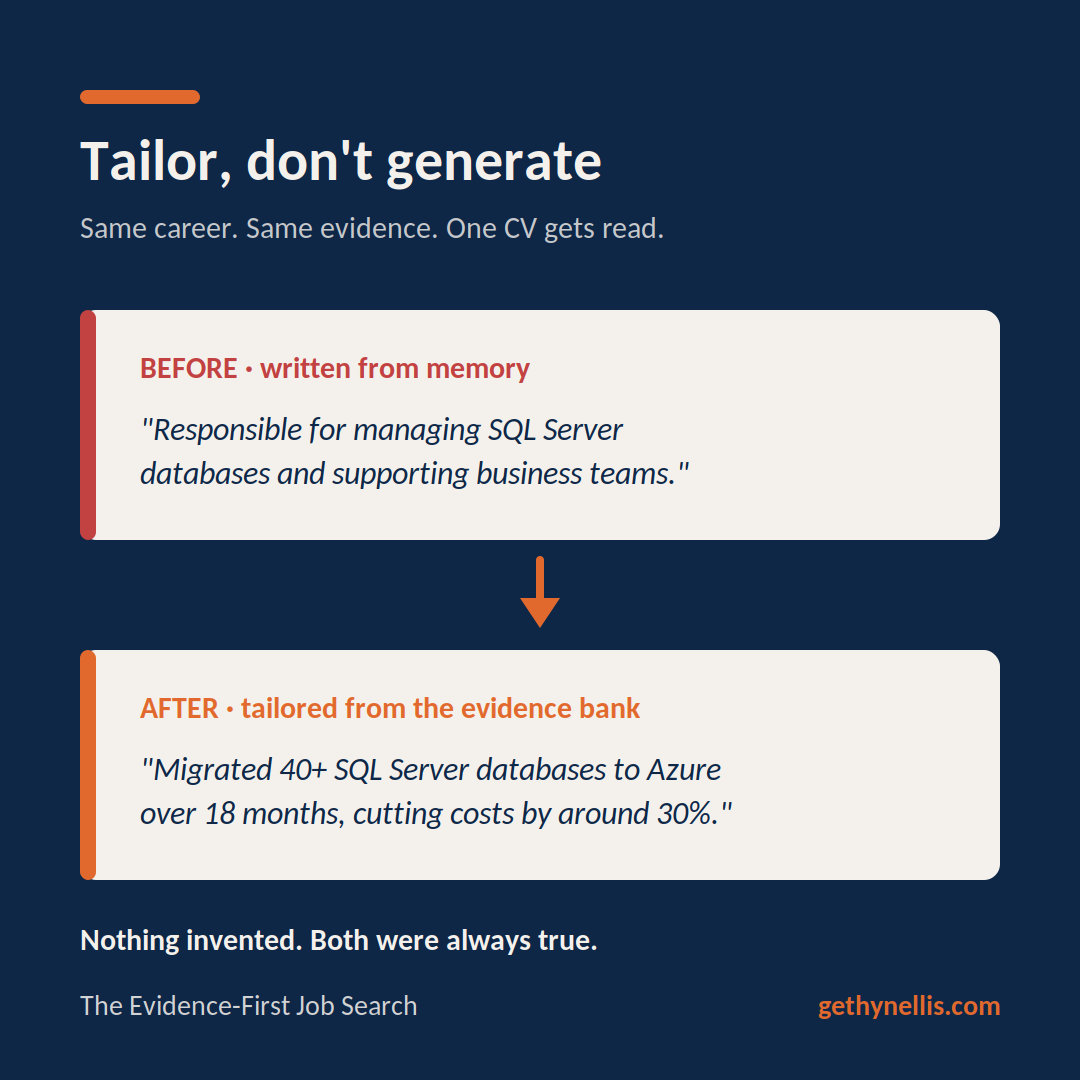
A real pattern, anonymised. The advert’s hard requirements included cloud migration experience and cost accountability.
Before, the generic bullet that sat on the CV for every application:
Responsible for managing SQL Server databases and supporting business teams.
After, tailored from the evidence bank against those decoded requirements:
Migrated 40+ SQL Server databases to Azure over 18 months, reducing licensing and hosting costs by around 30%.
Nothing was invented. Both sentences were always true. The second one existed in the evidence bank; the first is what happens when a CV is written from memory and left alone for three years. The tailoring pass simply put the right true thing in front of the right requirement.
The terminology pass
One more step before the CV goes anywhere, and it is the quality-control pass most people skip:
Compare my tailored CV against the advert. List every place the advert and my CV describe the same skill or experience in different words. Recommend where aligning my wording to the advert’s is accurate, and where it would overstate what I did. Do not change anything; report only.
Screening layers score on terminology match. If the advert says ‘stakeholder management’ and your CV says ‘working with business teams’, you may be describing identical experience and scoring as a gap. The alignment pass closes that, with the same honesty rule attached: mirror the language only where the mirror is accurate.
What this does not do
The series rule applies here more than anywhere. Tailoring does not make weak evidence strong. If the decode scored you a 5 and the evidence bank is thin against the hard requirements, no rewrite fixes that, and attempting to prompt your way around it produces exactly the manufactured content that detection software and sceptical hiring managers are hunting for.
What tailoring does is stop strong evidence losing to bad presentation. In a market where the first reader is an algorithm and the second is a human with ninety seconds, that is worth doing properly on every 8+ match, and not at all on the applications you should not be sending.
The next post takes this into Phase 3: cover letters, and the AI-detection test every application should pass before you submit it.
Get the full framework
This post is part of a series drawn from my whitepaper, The Evidence-First Job Search: a complete framework for using AI across job search, applications and interviews, with a 15-prompt library, an evidence bank template, and a 30-day plan. It is free to download.
0 Comments