
The AI Adoption Gap: why your people are ahead of your organisation
Here is a number that should worry every IT Director in a mid-sized UK organisation. According to the ONS, around 55% of employees say they use AI for work or education. Only 35% of businesses with ten or more staff say they have adopted AI. And of those adopters, just 10% describe their use as extensive.
Read that again. Your people are using AI. Your organisation, officially, mostly is not. That mismatch is what I call the AI adoption gap, and in twenty years of consulting I have rarely seen a problem land so squarely on the CIO’s desk with so little warning.
The conclusion I keep coming back to with clients is this. You do not need an AI strategy so that people start using AI. They already are. You need one so they use it safely, consistently and in ways you can measure.
What the AI adoption gap actually looks like
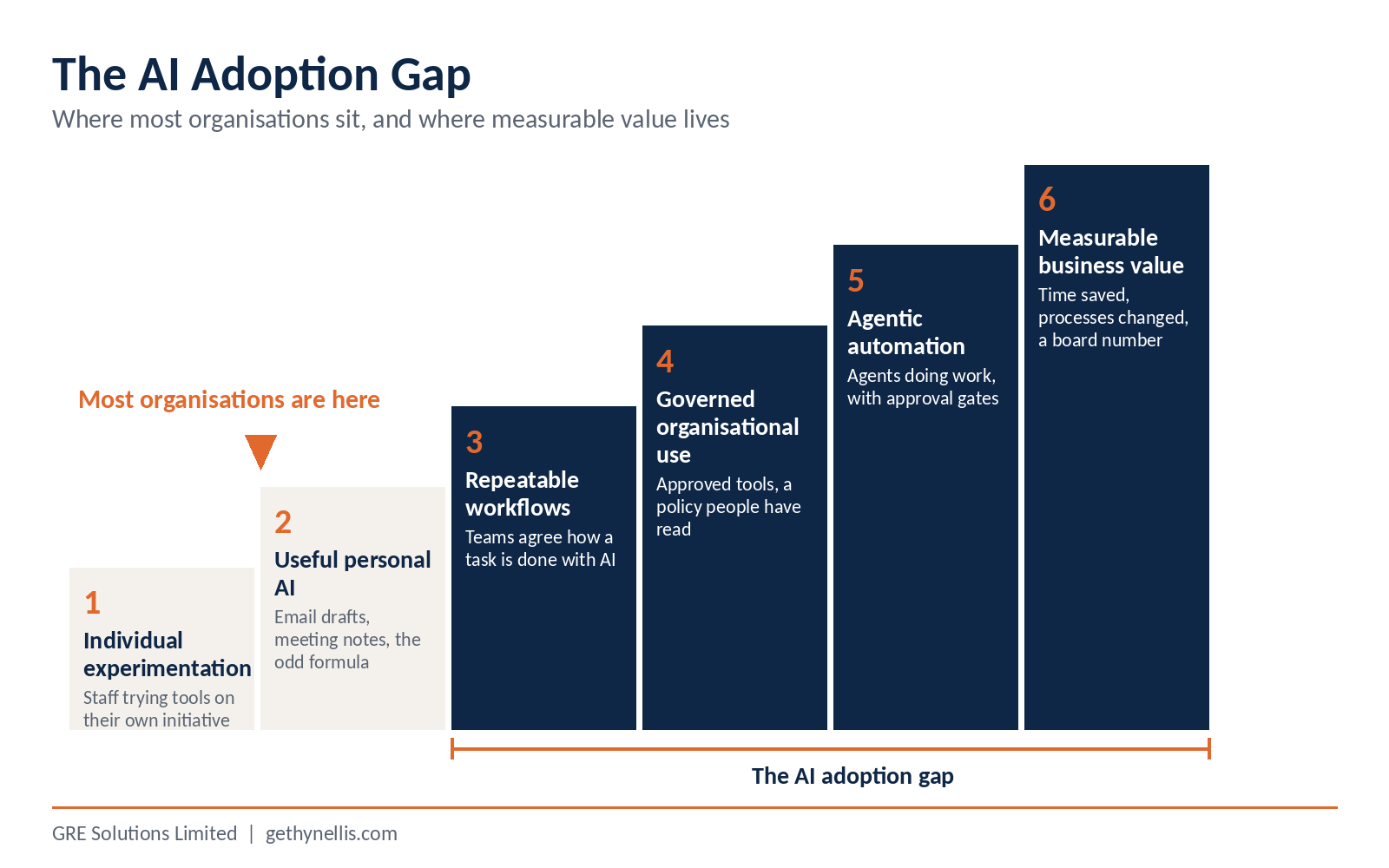
Most organisations I work with sit somewhere on this ladder.
- Individual experimentation. Staff trying ChatGPT, Copilot or Claude on their own initiative.
- Useful personal AI. A few people have made it part of their day. Email drafts, meeting notes, the odd spreadsheet formula.
- Repeatable workflows. Teams have agreed how a task gets done with AI, and it gets done that way every time.
- Governed organisational use. Approved tools, a policy people have read, permissions that have been checked.
- Agentic automation. Agents doing work, not just answering questions, with proper approval gates.
- Measurable business value. Time saved, processes changed, a number the board recognises.
The overwhelming majority are between stages one and two. The gap is everything between there and stage six. And the ONS data backs that up: the average number of AI technologies in use per adopting business has crept from 1.4 to 1.6 since late 2023. Adoption is wide and shallow.
The eight AI adoption pain points I hear from CIOs
These are the problems that come up in almost every readiness conversation I have with charities, professional services firms, schools, hospices and colleges on the Microsoft stack. I have put them in rough order of how often they surface.
1. “We don’t know what to use AI for”
This is the big one, and the research agrees. DSIT’s January 2026 AI adoption study found that 71% of businesses had not identified a use for AI. Even among businesses already using it, 30% said finding uses was holding back wider adoption.
That tells you something important about how to buy help. Generic “AI training” is a weak purchase if nobody knows which processes the training should change. What works is identifying the five to ten places where AI produces measurable value, prioritising them, and building the enablement around those.
2. “People are already using it and I have no control”
Staff are pasting donor lists, pupil data and client information into free tools. The IT lead knows it is happening, has no acceptable-use policy, and is quietly hoping not to be the organisation that ends up in the local paper.
The fix is not a ban. Bans push usage further into the shadows. The fix is an approved-tool list, a policy written in plain English that a trustee could understand, and a route for people to ask for something new.
3. “We bought Copilot and adoption is patchy”
The licences are on the tenant. A handful of enthusiasts use it daily. Most people opened it once after the rollout session and have not been back. Meanwhile the finance director is asking what the monthly spend per user is buying.
Product-led training does not fix this. Role-based enablement does: what does a fundraiser, a fee-earner, a head of year or a ward administrator actually do on a Tuesday, and where does Copilot remove twenty minutes of it?
4. “Our people can use AI, but not properly”
Being able to ask ChatGPT a question is not the same as being productive with AI. DSIT found 54% of AI-using businesses cited limited skills as a barrier, rising to 64% among mid-sized businesses. Only 11% of businesses had trained more than half their workforce.
I would frame the skills gap as a staircase rather than a prompting problem: prompting, then task augmentation, then workflow redesign, then automation, then building agents, then governing them. Most organisations have climbed one step.
5. “We’ve done pilots but nothing reaches production”
The demos were impressive. Six months later nothing has changed in how work actually gets done. DSIT reports 26% of AI-using businesses struggle to integrate and scale AI projects, and agentic AI is the technology they expect to be hardest to implement.
The missing piece is usually a defined path: experiment, then governed use case, then working agent, then production readiness with someone accountable at each gate.
6. “Governance is slowing everything down”
Or, more often, governance does not exist. The 2026 UK Business Data Survey found only 17% of AI-using businesses had any AI policy or guidance, formal or informal. Medium-sized businesses were at 22%.
The questions a CIO needs answered are operational, not philosophical. What data can go into Copilot? Can staff use ChatGPT? Who approves an agent? Can an agent update the CRM? Who owns the output and how do we audit it? Answer those and most of the fear goes away.
7. “We can’t show a return”
A licence is not adoption. Adoption is not behaviour change. Behaviour change is not productivity. Productivity is not a financial return. Each of those steps needs evidence, and almost nobody sets a baseline before they start.
“We trained 75 people” is not a result. “Six weeks on, 62 people are actively using the new workflows, three processes have changed and roughly 180 hours a month have been removed” is a result. The difference is measurement designed in at the start.
8. “The landscape changes every five minutes”
Microsoft is talking about Copilot, Copilot Studio, Foundry and Fabric. Staff are asking for ChatGPT and Claude. Developers are talking about MCP and coding agents. The CIO does not want another model comparison. They want someone to say: for your organisation, these are the four capabilities that matter, these are the tools I would permit, and these are the things to ignore for now.
The pain underneath the pain: your data
There is a ninth problem that sits beneath the other eight, and it is the one most AI consultancies skip because they do not come from a data background.
Once a client moves past drafting emails and summarising meetings, the conversation changes fast. Where is the data? Who owns it? Is SharePoint structured so Copilot finds the right version? Have permissions ever been audited, or will Copilot cheerfully surface the HR folder to anyone who asks? Which system is authoritative? Can an agent be trusted to act on it?
DSIT lists data complexity as an adoption barrier that grows with organisational size. In my experience it grows with ambition too. Every Copilot Studio agent that fails in a mid-sized organisation fails for the same reason: the knowledge sources underneath it were never fit for purpose. This is where AI adoption stops being a training exercise and becomes a data platform question spanning Microsoft 365, Power Platform, Fabric and SQL Server.
Five problems, one journey
If you strip the eight pains back, they reduce to five things an organisation has to get right, in roughly this order: strategy, governance, skills, use cases and scale. Miss one and the others wobble. Get them in sequence and the AI adoption gap closes on its own.
The practical starting point is honest diagnosis. Where are you on the ladder? Which of the eight pains are actually yours? What is the one use case you could take to production in the next quarter, and what data, policy and skills would it need? I have written up the fuller version of that thinking in the AI Adoption Playbook if you want the long-form treatment.
The short version is this. Your people are already experimenting. The job is turning that experimentation into safe, repeatable, measurable value before the gap between them and the organisation gets any wider.
Find out where you actually are
If any of those eight pains sounded uncomfortably familiar, the fastest next step is to see where your organisation sits on the ladder and which gaps matter most. The AI Readiness Assessment takes a few minutes and gives you a clear picture of strategy, governance, skills, use cases and scale, plus what I would tackle first. Run it, and if you want to talk through the results, get in touch.
Frequently asked questions about the AI adoption gap
What is the AI adoption gap?
The AI adoption gap is the distance between individual staff experimenting with AI tools and an organisation using AI in a governed, repeatable and measurable way. Most UK mid-sized organisations sit at the experimentation end. Closing the gap means moving through defined workflows, governance, agentic automation and, finally, business value the board can see.
Why do employees use AI more than their employers officially do?
Because the tools are free, immediate and useful. ONS data shows around 55% of employees use AI for work or education while only 35% of businesses report adopting it. Staff are solving their own problems ahead of any organisational decision, which is why adoption is happening whether or not IT has designed for it.
Do we need an AI policy if we only use Microsoft Copilot?
Yes. Copilot respects your existing permissions, so any oversharing in SharePoint becomes visible instantly. A policy also needs to cover the tools people use outside Copilot, what data can be entered, who approves an agent and who owns the output. Only 17% of AI-using UK businesses have any policy at all, so this is a gap worth closing early.
How do you measure ROI on Microsoft Copilot licences?
Set a baseline before rollout, then track active use, workflows changed and hours removed rather than seats assigned. A licence is not adoption, and adoption is not productivity. A credible result reads like this: six weeks on, 62 of 75 trained staff are active, three processes have changed and roughly 180 hours a month have been saved.
Why do AI pilots never reach production?
Usually because there is no defined path from experiment to live use. DSIT found 26% of AI-using businesses struggle to integrate and scale AI projects. The fix is a staged route: experiment, then a governed use case, then a working agent, then a production gate with someone accountable for data, approvals and ownership at each step.
0 Comments