
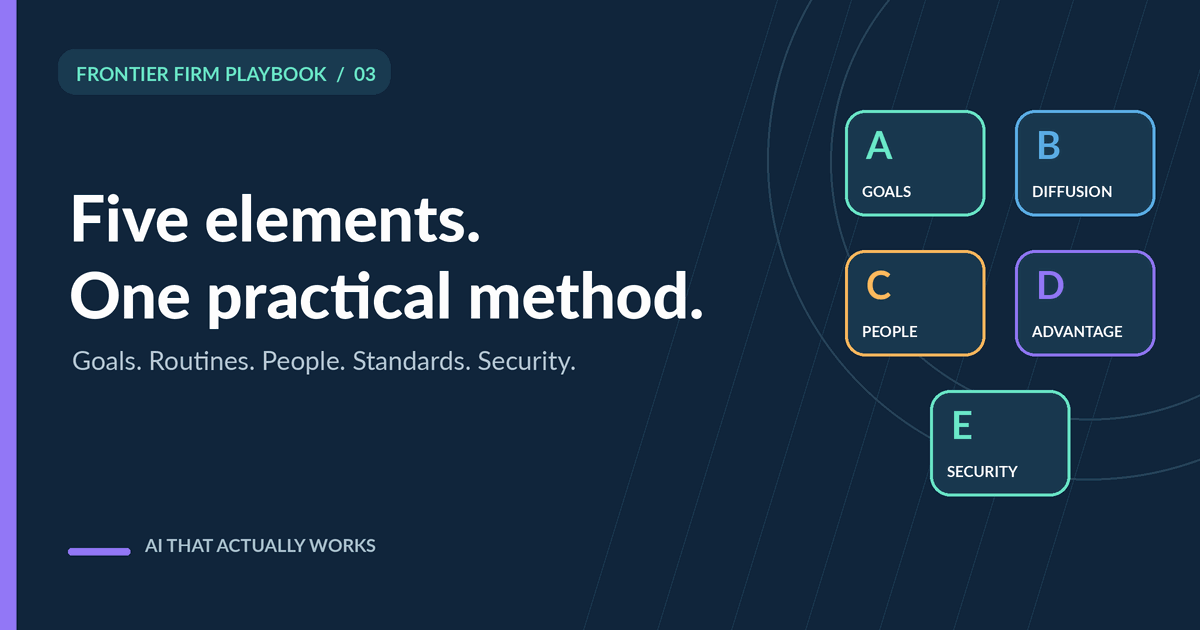
Microsoft has published the method it is using on itself. The Frontier Playbook runs to 44 pages and sets out five elements for becoming a Frontier Firm. I have read it so you can decide whether you need to, and I have a view on each part.
The original source is available in Microsoft’s Frontier Firm resources.
The quick answer: becoming a Frontier Firm means tying AI to business goals, building the routines that spread it through real work, bringing your people with you, writing down what makes you distinct so AI works to your standard, and securing all of it before you scale. It is a business change programme. The technology is the smaller part.

A. Set business ambition and goals
Microsoft anchors every initiative to four goals: enrich employee experience, reinvent customer engagement, reshape business processes and speed up innovation. Each has a named executive owner.
The line I like most is their framing of efficiency as the floor. Speed, quality and cost are expected. Growth, experience and innovation are where the larger prize sits. On every initiative they ask what bigger opportunity is being missed if the only return is cost out.
What I would do: write your AI goals in business language, three at most, each with one accountable owner. If your current plan is a list of use cases, you have a backlog and still need a strategy.
B. Build your diffusion engine
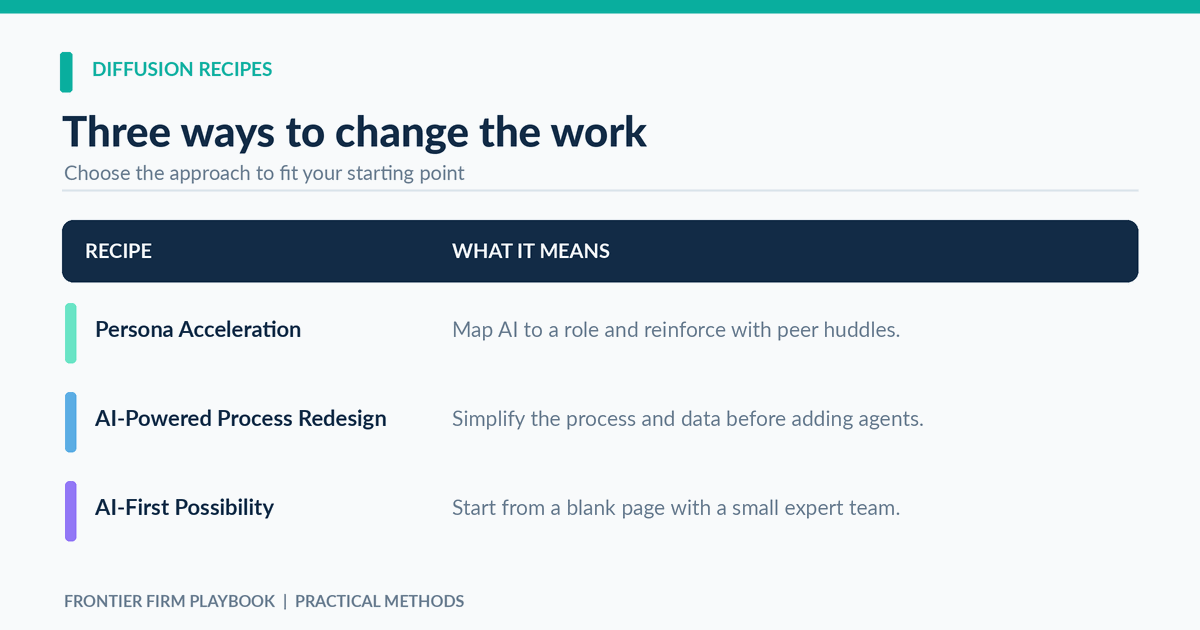
This is the core of the document. Microsoft reviewed more than a hundred of its own internal case studies and concluded that AI rollout cannot be treated as an IT project. It offers three approaches, which it calls recipes.
- Persona Acceleration. Map AI to the real working week of a specific role, then reinforce it with weekly peer huddles and visible manager use.
- AI-Powered Process Redesign. Map and simplify an end-to-end process, sort out the data, then introduce agents. Their phrase is ‘lean before agents’.
- AI-First Possibility. A small expert team starts from a blank page and assumes AI from day one. Microsoft says this is seldom the first one to scale.
There are two supporting ideas worth knowing. The first is that continuous improvement gives you a leaner version of the company you already have, while AI can add capability you could not afford before. You want both. The second is a four-stage measurement chain running from activity, through signs of real workflow change, to performance and finally business outcome, with realistic timescales from weeks to six months and beyond.
What I would do: start with Persona Acceleration for two or three roles, and run one Process Redesign alongside it where your data is in reasonable shape. Agree your measures before you begin. Licence activity tells you who logged in. It says nothing about whether the work changed.
C. Invest in your people
Microsoft calls this possibly the most important section, and one of its own leaders admits they focused too much on technology at the start. I agree with the emphasis.
The guidance covers four things: talk to staff honestly about what is changing, rethink roles and the manager’s job, turn change management into continuous experimentation, and give people control over their own careers. The Work Trend Index data they quote suggests organisational interventions have twice the effect on AI effectiveness of work on individual mindset and skills.
I would add one caution. A warning sits in here about automating away junior work and hollowing out the pipeline that produces your senior people. Every organisation tempted by quick headcount savings should read that page.
What I would do: brief managers first and expect them to use the tools in front of their teams. Say plainly what you know and what you do not. Silence from leaders creates more anxiety than honest uncertainty.
D. Codify your advantage and controls
This is the newest thinking in the document and the part most organisations have not started. The argument is that your advantage is often unwritten: judgement, taste, the way you do things. A general-purpose model knows none of it, so its output drifts towards the average.
Microsoft’s answer is private evals: tests that describe what good looks like for you, used to score and improve AI output over time. Pair that with architecture that keeps your prompts, data and learning inside your own boundary and lets you change models without starting again.
This is close to my own work. My Ignite session was about testing whether you can trust a Fabric data agent, and the principle is the same. If you cannot measure the answers against a known standard, you are relying on hope.
For a practical example, see testing whether you can trust a data agent.
What I would do: pick your three most valuable outputs and write a short, testable definition of good for each, with real examples. Build a small benchmark set of questions with agreed answers. That is your first eval, and you can run it by hand.
E. Safeguard your security
The final element is short and blunt. Agents are becoming independent actors with broad access, and security models built around human users will not keep up. Microsoft frames four jobs: defend with AI, enable agents safely with identities and permissions of their own, secure and classify your data, and manage your exposure before attackers or agents find the gaps.
What I would do: treat data classification and permissions as a precondition for scaling, and give every agent an owner and an audit trail. Their closing summary asks that AI actions be traceable, auditable and reversible. That is a sound test for any agent you plan to deploy.
Where I would push back
It is a good document, and it is also Microsoft’s own experience, at Microsoft’s scale, on Microsoft’s platform. The results quoted are self-reported and the company is careful to say they are not guarantees. Take the method seriously and set your own numbers.
The takeaway
Becoming a Frontier Firm is less about agents than the headlines suggest. Goals, routines, people, standards and security: four of the five elements are management work. Organisations that do that work will get a return from AI. The ones that skip it will get a licence bill.
For the wider series, read why Copilot training alone is no longer enough and how to scale the playbook down for a mid-sized organisation. You can also check your starting point.
Put element B and C to work this December
If you want to start with the part that pays back quickest, start with your people and their daily routines. On 14 and 15 December I am running half-day Copilot workshops that are practical and role-focused, built to leave your team with techniques they can use and teach straight away. Take a look at the December Copilot workshops and book your places.
0 Comments