
My session at Microsoft Ignite this year asked a simple question: can you trust your Fabric data agent? The honest answer is that it depends on how much the agent understands about your business. That is where the Fabric ontology comes in, and it is the part of Fabric IQ I think most teams are underestimating.
Here is my take. Most wrong answers from data agents are not model problems. They are meaning problems. The agent can see your tables. It has no idea what they mean.
What is a Fabric ontology?
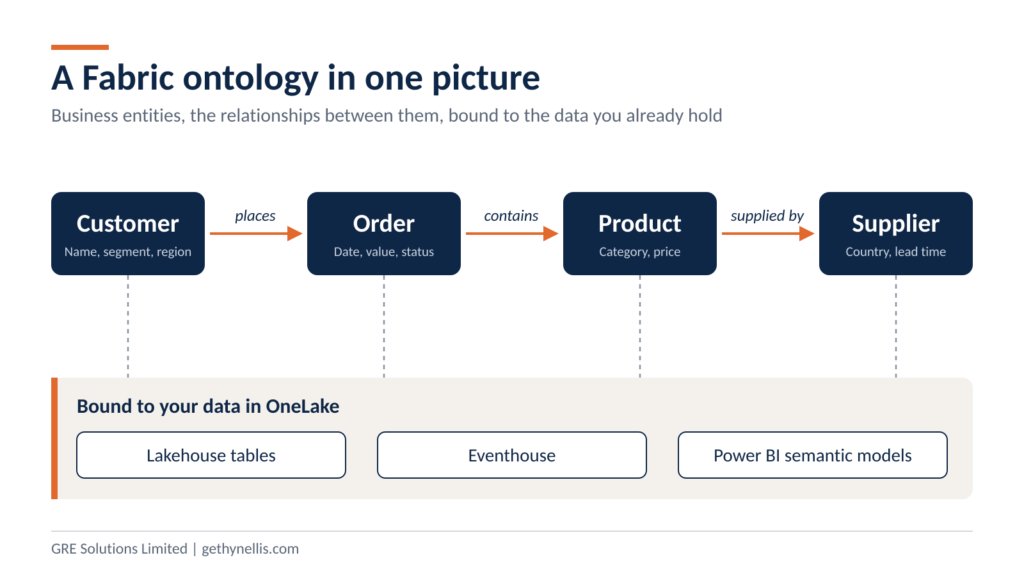
A Fabric ontology is a model of your business, held in Fabric IQ, that describes the things you care about (customers, orders, products, sites), how they relate to each other and the rules that govern them. It is bound to the data you already hold in OneLake, so agents can reason in business terms instead of tables and columns.
Under the bonnet it is stored as a graph. Entities are the nodes. Relationships are the edges. Customer places Order. Order contains Product. Product is supplied by Supplier.
If the word puts you off, ignore it. Think of it as the handbook a new starter would need before you let them loose on your data.
Schema, semantic model, ontology: three different jobs
The confusion I hear most is ‘we already have a semantic model, so why do we need this?’ Fair question. They do different jobs.
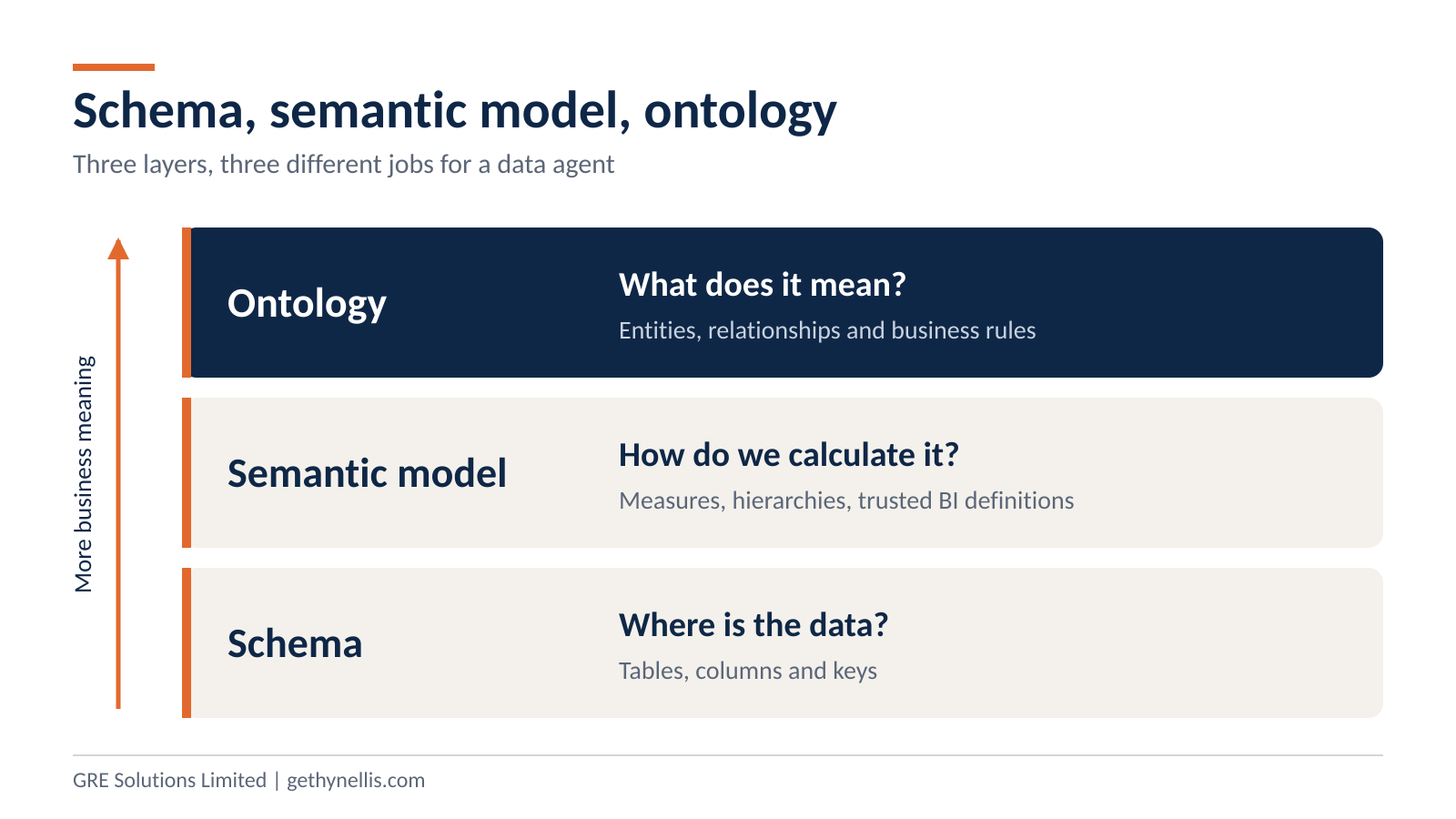
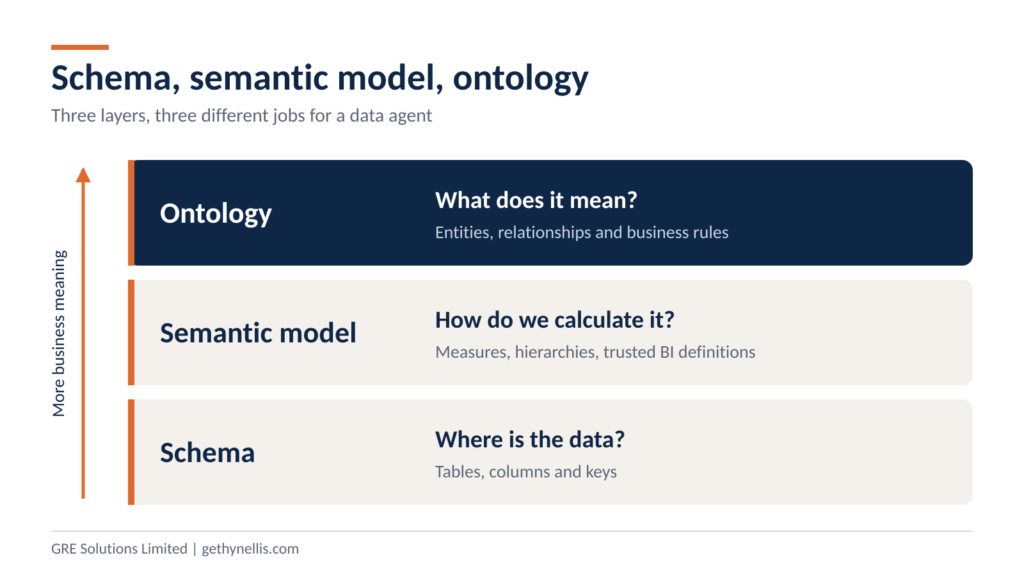
- Schema tells you where the data is. Tables, columns, keys.
- Semantic model tells you how to calculate it. Measures, hierarchies, the trusted definitions behind your Power BI reports.
- Ontology tells you what it means. The entities, the relationships between them and the business rules that apply.
The semantic model tells the agent how to count. The ontology tells it what it is counting and why it matters.
Your semantic model work is not wasted. Fabric can generate a starting ontology from an existing semantic model, which gets you past the blank page. Treat that output as a first draft. It gives you structure, and you still have to finish the job by hand.
Why a Fabric ontology matters for data agents
Point a data agent at raw tables and it has to guess. Which join? Which of the three date columns? Does ‘active customer’ mean a login in the last 30 days or a live contract? It will pick one, sound confident and sometimes be wrong.
Ground the same agent in an ontology and three things change.
1. Grounding
The user’s question is translated into a query over your business entities and relationships, not a best guess at a SQL join. Fewer guesses means fewer confident wrong answers.
2. Consistency
The ontology is one definition that many agents can share. A Fabric data agent, an agent built in Foundry and an agent in Copilot Studio can all work from the same model of the business. Without that, every agent ends up with its own version of the truth, which is the spreadsheet problem all over again with a chat window on the front.
3. A route to action
Because rules and constraints sit in the ontology, Microsoft’s direction is for agents to move from answering questions to taking governed, auditable actions. I would treat that as the destination, not the starting point. Get the answers right first.
The catches
I am sceptical of anything that arrives with a new three-letter suffix, so here is the other side.
- It is in preview at the time of writing. The authoring experience has already changed once during 2026. Check the current documentation before you commit a production design to it.
- It will not fix a bad data model. An ontology bound to messy data gives you well-described mess.
- The hard part is not technical. Someone has to agree what ‘customer’ means. That is a conversation between people, and no tool has that conversation for you.
- It needs an owner. The business changes. If nobody maintains the ontology, it drifts, and the agents drift with it.
Where I would start
- Pick one bounded domain. Customer orders, not ‘the enterprise’.
- Model two or three entities. Customer, Order and Product is plenty for a first pass.
- Generate from your existing semantic model, then correct it with the people who run that part of the business.
- Write your test questions first. Twenty real questions with known correct answers. Run them against the agent before and after the ontology. If the score does not move, you have learnt something useful cheaply.
That last step is the one most teams skip. It is also the only way to prove to a sceptical board that the agent can be trusted.
The takeaway
We spent the last two years obsessing over models and prompts. The bigger gap was always context. A Fabric ontology is Microsoft’s answer to that gap for data agents: a governed, shared description of what your business means, sitting on top of the data you already have. It is early, it needs real effort from the business and it is worth a small, measured pilot now.
Get your people ready for agents
Good grounding is half of it. The other half is people who know how to ask good questions and challenge the answers. I am running half-day Copilot workshops on 14 and 15 December for exactly that reason. Have a look at the December Copilot workshops and book a place for your team.
0 Comments